103 years of the Republic: science as our guide

On 29 October 1923, the Republic of Türkiye was proclaimed. As we mark its 103rd anniversary, we want to look back at one idea the young Republic placed at its centre and that still shapes how we work in the lab every day: science as a guide.
A sentence spoken to teachers
In September 1924, at a tea reception given by teachers at the İstiklâl Ticaret Okulu in Samsun, Atatürk addressed the people who would educate the Republic's first generations. The best-known sentence of that speech is:
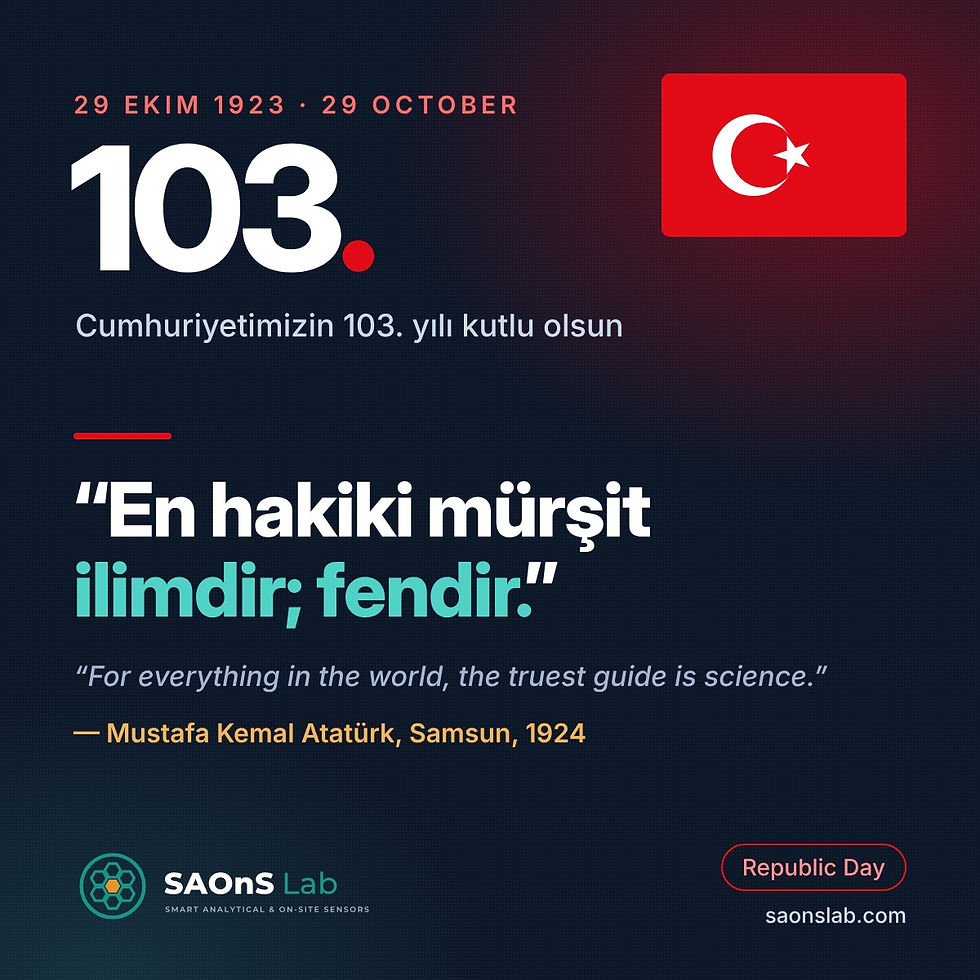
"Dünyada her şey için; uygarlık için, hayat için, başarı için en hakiki mürşit ilimdir; fendir."
"For everything in the world, for civilisation, for life, for success, the truest guide is science."
The speech does not stop there. Atatürk added that looking for a guide outside science is carelessness, ignorance and error ("İlim ve fennin dışında rehber aramak dikkatsizliktir, bilgisizliktir, yanlışlıktır."). He also stressed that science is not a fixed set of rules: one has to grasp how it matures and follow its progress over time, and applying rules drawn thousands of years ago as they are today "is certainly not being within science".
It is worth remembering who the audience was. In the same speech, Atatürk said that after the family, a child's first inspiration comes from the teacher at school. The message about science was, from the start, a message about education.
From a sentence to institutions
Within a decade, the idea was turned into institutions. In 1933, following a report by the Swiss professor Albert Malche, who had been invited to Türkiye on Atatürk's order, Law No. 2252 closed the Istanbul Darülfünun and founded Istanbul University in its place, with a European model of university administration and teaching.
The reform also opened Turkish universities to German-speaking scholars who had been forced to leave their countries for political reasons. They were expected to learn Turkish, to teach in Turkish and to pass their knowledge on to young Turkish academics, and their work helped lay the foundations of faculty development in the country.
Ankara, the new capital, followed. The Faculty of Language, History and Geography was founded in 1935, and Ankara University, established through Atatürk's direct initiative, was officially founded in 1946. Its Faculty of Pharmacy, home of SAOnS Lab, was established in 1960.
Why it still matters in the lab
The second half of the Samsun quote fits analytical chemistry remarkably well. Science is a guide not because it is fixed, but because it keeps checking itself. In practice, that means:
Evidence first: a claim about a sample is only as good as the measurement behind it.
Validation, not assumption: a method earns trust through tests of accuracy, precision, selectivity and limits of detection, and it is re-checked when conditions change.
Keeping up with progress: new materials, sensors and data tools change what we can measure; yesterday's protocol is a starting point, not the final word.
Passing it on: knowledge only lasts if it is taught, so training the next generation is part of the job.
At SAOnS Lab
At SAOnS Lab, Ankara University Faculty of Pharmacy, we try to honour that legacy every day: by training young researchers and by building electrochemical sensors that turn careful measurement into useful answers for health and the environment.
Happy Republic Day! Which teacher or scientist first showed you that science can be a guide? We would be glad to hear from you.
Sources
Atatürk Kültür, Dil ve Tarih Yüksek Kurumu (AYK), Atatürk Araştırma Merkezi. Atatürk'ün Söylev ve Demeçleri: "Samsun Öğretmenleriyle Konuşma" (Hâkimiyet-i Milliye, 25.09.1924). https://www.atam.gov.tr/ataturkun-soylev-ve-demecleri/samsun-ogretmenleriyle-konusma
Namal, Y., & Karakök, T. (2011). Atatürk and the university reform (1933). Journal of Higher Education and Science, 1(1), 27. https://doi.org/10.5961/jhes.2011.003
Elçi, A., & Kadercan, P. (2023). Türkiye'de Almanca konuşan göçmen profesörlerin eğitim gelişimi girişimleri. Anadolu Üniversitesi Sosyal Bilimler Dergisi, 23(Özel Sayı), 331–356. https://doi.org/10.18037/ausbd.1316536
Ankara University. History. https://iso.ankara.edu.tr/en/history/


Comments